Overview
Lenders use business data to answer three questions before making a small or medium-sized business (SMB) loan: Who is borrowing, can the business repay, and what debts or claims already exist? Registration records, financial information, and public filings answer different parts of that review.
Compare the application with records suited to each question. A registered business may still lack cash to repay, and a matching tax ID does not establish the applicant’s authority to borrow.
In brief
- Check business identity, cash flow, and existing debts before setting loan terms.
- Check the signer’s authority separately from the business’s registration and tax ID.
- Recent bank transactions can reveal changes since the last financial statement.
- Lien searches find possible claims on assets, not a complete debt balance.
Three questions business data helps answer
A lending decision depends on both who is borrowing and how the loan will be repaid. Organize the evidence around three questions so identity checks, financial analysis, and other creditors’ claims each receive the review they need:
- Business identity and authority: Compare the legal name, registration number, and state status with the application. Review the documents authorizing the signer to borrow. Do not use a registration or tax-ID match as a substitute for that separate review.
- Finances and cash flow: Use bank transactions, accounting records, and tax returns to assess revenue, expenses, and money available for loan payments. Review recurring income and obligations rather than relying on one day’s balance.
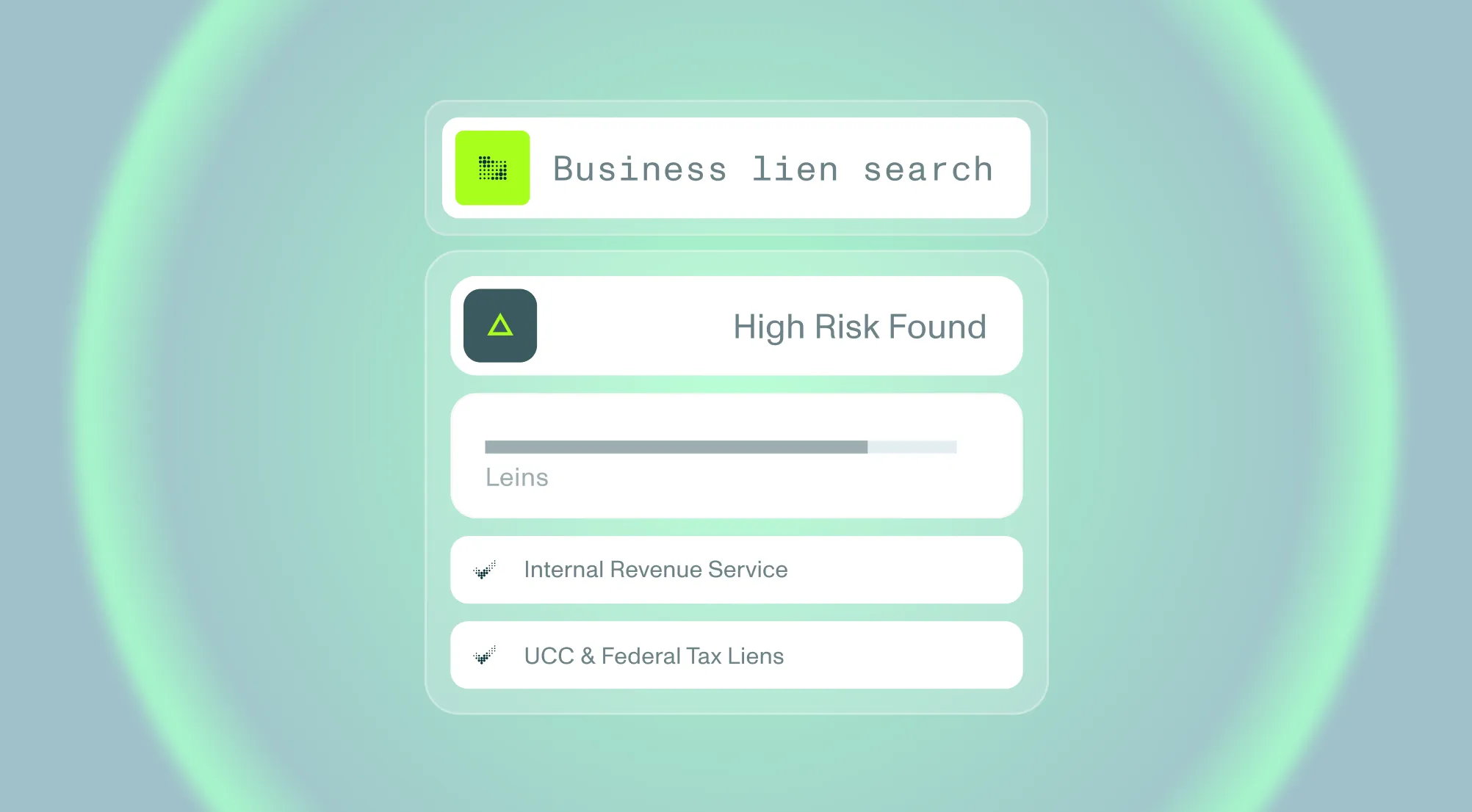
- Existing debts and creditor claims: Review the borrower’s debt schedule alongside public records. Uniform Commercial Code (UCC) financing statements are public notices of claimed rights in business assets. Tax liens concern unpaid taxes, while court judgments record court decisions. These records need different follow-up.
Match each question to the right source
A source may answer one lending question while leaving another unresolved. Match each question to the relevant records, then identify any gaps that need additional evidence:
- State business registrations: Check the formation date, business structure, and status shown by the filing office. Investigate an inactive or dissolved status under the relevant state’s rules rather than assuming it proves the business stopped operating.
- IRS name and tax ID matching: A Taxpayer Identification Number (TIN) identifies a taxpayer. An Employer Identification Number (EIN) is one type used by businesses. IRS TIN matching checks whether a name-number pair agrees with IRS records. It does not verify ownership or permission to borrow.
- UCC filings and public records: Read the debtor name, filing dates, and assets described, such as equipment or money customers owe the business. Check later filings and current loan information before treating a notice as an unpaid obligation.
- Bank account data: With the borrower’s permission, review available transaction history for changing balances, recurring payments, and unexplained deposits. Confirm the period and accounts covered so a short or incomplete feed does not look like the business’s full history.
Reconcile financial documents with recent activity
Profit-and-loss statements, balance sheets, and tax returns remain useful, but they describe particular periods. They may not reflect a sales decline or new loan after the reporting date. Compare them with recent transactions rather than discarding them in favor of a single feed.
Borrower-supplied files can also be altered. Investigate differences between reported sales, bank deposits, and accounting records, allowing for transfers and the timing of customer payments. A discrepancy is a reason to ask for evidence, not proof of fraud.
Middesk supports business registration, name-and-tax-ID, and address checks. Its public-record searches can add information about other claims on assets. Lenders still need financial analysis and their own credit policy to assess repayment.
Frequently asked questions
What data is required to verify a business before lending?
The checks depend on the lender, product, business structure, and applicable rules. Common inputs include registration records, a name-and-tax-ID match, address evidence, and information about the people who own or control the business. Check borrowing authority separately, then review financial capacity and existing obligations.
Why are business credit bureau scores insufficient on their own?
A credit score summarizes the information available to its provider. A thin file contains little reported credit history, which leaves less evidence to assess rather than proving poor creditworthiness. Recent financial records and business verification can answer questions the score does not.
What is the difference between personal and business underwriting data?
Personal underwriting reviews an individual’s income, debts, and payment history. Business underwriting also examines the company’s identity, cash flow, and existing obligations. If an owner gives a personal guarantee, a promise to repay if the business does not, the lender may review that person’s finances too.
Why can bank deposits differ from reported revenue?
Deposits can include loan proceeds, owner contributions, and transfers between accounts. Sales may also be recorded before customers pay. Match the periods and trace unexplained deposits before treating all money entering an account as revenue.

New to Middesk?
Talk to our team to see what business identity intelligence looks like inside your workflow.
Get a demo